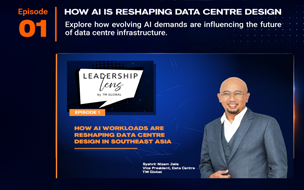


Global tech companies looking to expand into ASEAN face both immense opportunity and rising complexity. ASEAN’s fast-growing digital economy is projected to reach US $600 billion by 2030, propelled by rapid cloud adoption, increasing AI workloads, and surging mobile data usage, according to a report from the ARC Group.
At the same time, tightening data sovereignty laws require companies to store and process data locally, forcing tech companies to invest in local infrastructure.
From real-time AI services to latency-sensitive digital platforms, success in this region demands more than raw compute power.
In the age of scalable AI, proximity is no longer optional. To deliver intelligent, real-time services across ASEAN, tech companies need digital ecosystems that are flexible, localised, and built to respond in milliseconds. It requires a mix of edge infrastructure, regional connectivity, and colocation-ready facilities that bring compute closer to users, reduce latency, and enable compliance with evolving regulations.
AI is pushing tech companies to turn to datacentre infrastructure that can be a gateway into ASEAN.
"Enterprises are also choosing to house an ever-growing proportion of their datacentre gear in colocation facilities, further reducing the need for on-premises datacentre capacity. The rise of generative AI technology and services will only exacerbate those trends over the next few years,” says chief analyst John Dinsdale, Synergy Research Group.
Tech companies may be equipped to support advanced AI workloads, but operating in ASEAN presents unique challenges. Real-time AI requires low-latency infrastructure that must be located close to users. They also need to meet local data regulations in each country. And if infrastructure can’t deliver reliable performance during peak usage, the value of AI quickly diminishes.
In ASEAN, success with AI depends on a combination of speed, compliance, and reliability.
Real-Time AI Depends on Proximity
Speed builds trust. Responsiveness is critical to how users perceive and trust AI services.
Tech companies implementing AI services in ASEAN, whether for fraud detection in financial platforms, predictive maintenance in manufacturing, or real-time personalisation in e-commerce, need infrastructure that performs in real time. Without that, AI risks becoming a liability instead of a differentiator.
Real-time AI depends on proximity to data and users, supported by GPU-accelerated compute and edge deployments. Yet according to Cisco, only 13% of organisations are fully prepared to support AI at scale, highlighting a significant infrastructure gap. The challenge is even greater for tech companies entering ASEAN. Without in-region capacity, data must travel thousands of kilometres, adding friction, increasing risk, and undermining the very advantage AI is meant to deliver.
TM Global enables low-latency AI experiences through distributed edge nodes and GPU-powered infrastructure, placing compute closer to users across ASEAN.
Localisation is Key to Regional Expansion
Every country brings its own playbook of data residency rules, cloud sovereignty requirements, and AI-specific governance. From Malaysia’s RMiT to Indonesia’s strict data localisation, regulators are making it clear: AI workloads must operate inside national borders.
The ARC Group report observes: “With data sovereignty laws tightening in Thailand, Vietnam, Malaysia and Indonesia, companies are required to store and process data locally, more than ever. This regulatory shift is forcing cloud providers, and tech enterprises to invest in regional infrastructure.”
Adding new zones or spinning up more capacity won’t solve compliance if the infrastructure isn’t designed for sovereign hosting. Real-time AI-enabled workloads like LLM inference for local language apps, or dynamic ad serving depend on in-country processing to meet speed and privacy requirements.
With sovereign hosting, local access nodes, and compliance-ready infrastructure, TM Global helps tech companies meet regulatory requirements in every ASEAN market.
Reliable Infrastructure Enables Trusted AI
In the age of real-time AI, reliability means keeping models accurate, responses fast, and customers satisfied. Even a brief drop in performance can affect results, disrupt transactions, or cause compliance issues.
Infrastructure must offer redundancy within national borders, support failover paths that follow data laws, and maintain consistent performance during traffic spikes.
In ASEAN markets where businesses rely on AI for key operations like customer service and pricing, reliability is critical. Reliability now requires multi-zone redundancy within national borders, failover paths that respect data sovereignty, and network fabrics that keep inference speeds consistent during sudden spikes in demand.
Tech companies that fail to meet this standard risk losing both revenue and customer trust. TM Global delivers enterprise-grade reliability with Tier III-certified data centres, in-country redundancy, and intelligent failover paths that keep AI workloads stable under pressure.
The Infrastructure Behind Scalable AI in ASEAN
Each of these challenges, real-time performance, sovereign scalability, and AI-grade reliability, cannot be solved with generic cloud capacity. They require an infrastructure partner that understands ASEAN’s regulatory landscape, has the regional footprint to minimise latency, and keeps AI workloads secure and ready to scale within national borders.
TM Global offers a full stack of capabilities, including GPU-as-a-Service, edge infrastructure, high-capacity fibre, SD-WAN, direct peering, and advanced connectivity, to run, scale, and secure AI workloads across ASEAN. Tier III LEED certified data centres and strategically placed edge nodes bring compute closer to users and data, reducing latency and ensuring compliance with local regulations. A resilient cross-border backbone and dense peering ecosystem provide consistent, low-latency performance even under AI-intensive demand. data centres and strategically placed edge nodes bring compute closer to users and data, reducing latency and ensuring compliance with local regulations. A resilient cross-border backbone and dense peering ecosystem provide consistent, low-latency performance even under AI-intensive demand.
Together, these capabilities help tech companies expand across ASEAN seamlessly, while maintaining speed, compliance, and operational continuity.
TM Global gives you the foundation to rise to the challenge, and the advantage to lead.
To learn how TM Global can support your infrastructure strategy, get in touch with us.